


Futur Proche vs Futur Simple: Which One Should You Use? (With Examples)
“Je vais manger” or “je mangerai”? Both mean “I will eat”, and my students often ask me if there is really a difference. There is, but it’s much simpler than grammar books make it look. Here is the rule I give in class, with examples and a mini quiz at the end.
The short answer
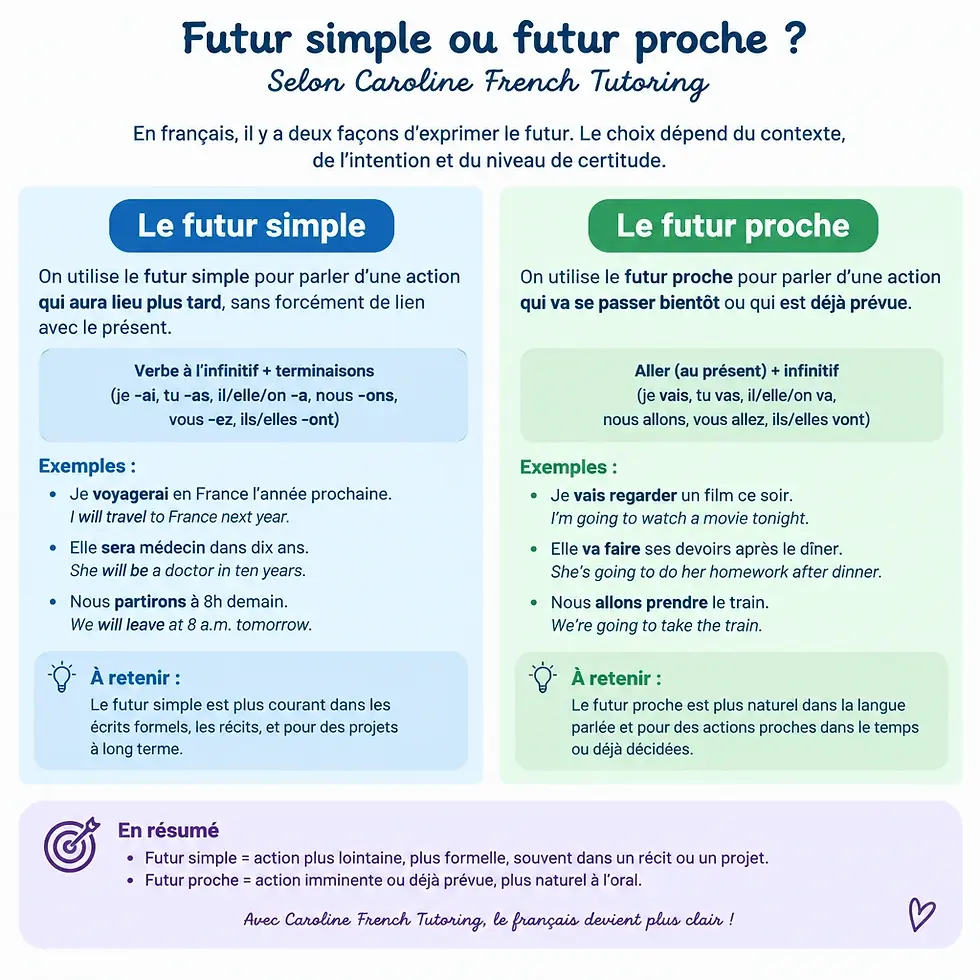
Futur proche (je vais manger): something close, planned, or already visible. It’s the future of everyday conversation.
Futur simple (je mangerai): something further away, less certain, a promise or a prediction. It’s also the future of written French.
If you only remember one thing: when you speak, the futur proche is almost always safe. The futur simple becomes essential in a few specific cases, which we’ll see below.
How to form the futur proche
Easy: the verb aller in the present + an infinitive.
je vais partir
tu vas partir
il / elle / on va partir
nous allons partir
vous allez partir
ils / elles vont partir
For the negative, the ne… pas goes around aller: Je ne vais pas partir.
How to form the futur simple
Take the infinitive and add these endings: -ai, -as, -a, -ons, -ez, -ont. For verbs ending in -re, drop the final e first.
parler → je parlerai
finir → tu finiras
prendre → il prendra
The endings are always the same, but some very common verbs have an irregular stem. These are the ones to learn first:
être → je serai
avoir → j’aurai
aller → j’irai
faire → je ferai
venir → je viendrai
pouvoir → je pourrai
vouloir → je voudrai
voir → je verrai
savoir → je saurai
devoir → je devrai
When to use the futur proche
An action that is about to happen: Dépêche-toi, le train va partir !
Something you can already see coming: Regarde ces nuages, il va pleuvoir.
A plan or decision already made: Ce week-end, on va visiter Versailles.
When to use the futur simple
A distant or uncertain future: Un jour, j’habiterai en Provence.
Promises: Je t’appellerai demain, promis.
Predictions and forecasts: Demain, il fera beau dans le sud.
After si + present: Si tu viens à Paris, on ira au café ensemble.
Formal or written French: emails, letters, instructions, news.
The trap English speakers fall into: quand + future
In English, you say “When I am in Paris, I will call you”, with a present after “when”. French is more logical: if the action is in the future, the verb after quand is in the future too.
✗ Quand je suis à Paris, je t’appellerai.
✓ Quand je serai à Paris, je t’appellerai.
Same with dès que (as soon as) and lorsque: Dès que j’aurai mes résultats, je te dirai.
Same sentence, different feeling
Je vais me marier. → it’s planned, the date is probably set.
Je me marierai. → one day, maybe, someday…
That’s really the heart of it: the futur proche feels concrete and close, the futur simple feels more distant or more solemn.
Mini quiz
Futur proche or futur simple? Try before looking at the answers.
1. Attention, tu ___ tomber ! (aller)
2. Un jour, je ___ le japonais. (parler)
3. Quand tu ___ à la gare, envoie-moi un message. (arriver)
4. Regarde, le film ___ commencer. (aller)
5. Si j’ai le temps, je ___ te voir. (venir)
Answers: 1. vas (futur proche, it’s about to happen) · 2. parlerai (distant future) · 3. arriveras (quand + future) · 4. va (imminent) · 5. viendrai (si + present → futur simple)
Want to go further?
The futur proche and futur simple are two of the 14 French tenses. If you want the full picture, read The 14 French Tenses Explained Simply, and if you’re working on the past, Passé Composé vs Imparfait: The Simple Rule.
And if you want to master all the tenses step by step, my self-study programme French Tenses in 3 Months was made exactly for that. Prefer to practise out loud with me? Book a lesson, in a café in Paris or online. À bientôt !


Comments